
Best Flooring for Allergy Sufferers — What Traps Dust and What Doesn’t
For allergy sufferers, your flooring choice directly affects how many allergens accumulate in your home. Carpet traps dust mites, pet dander, and pollen deep within its fibers, making complete extraction nearly impossible. Hard surfaces like hardwood, tile, and vinyl resist allergen embedding and clean more effectively with damp mopping or HEPA vacuuming. Maintaining indoor humidity between 30–50% further reduces dust mite proliferation. The right flooring decision goes deeper than surface material alone.
Key Takeaways
- Carpet is the worst flooring choice for allergy sufferers, as dense fibers trap allergens deep inside, making complete removal nearly impossible.
- Hardwood and tile are strong allergy-friendly options, featuring non-porous surfaces that prevent allergen embedding and allow easy damp mopping.
- Vinyl flooring resists mold and bacterial growth, with seamless installation eliminating gaps where allergens commonly accumulate.
- Low-pile carpet collects fewer allergens than high-pile varieties but still requires frequent vacuuming and periodic professional cleaning.
- Look for GREENGUARD Gold or FloorScore certifications to ensure low VOC emissions, reducing chemical triggers alongside allergen exposure.
Why Your Flooring Could Be Making Your Allergies Worse

When allergens accumulate in your home, your flooring is often the primary culprit. Certain flooring materials trap particulate matter, pet dander, pollen, and mold spores within their fibers or surface irregularities. This trapped debris continuously degrades indoor air quality as foot traffic and air circulation redistribute allergens into breathing zones.
Dust accumulation occurs differently across flooring types. Carpet fibers retain allergen sources deep within their pile, making complete extraction difficult even with regular vacuuming. Hard surfaces, while easier to clean, can harbor allergens within grout lines, seams, and micro-scratches. Smooth surfaces like tile are hypo-allergenic, making them an ideal choice for minimizing allergen accumulation in your home.
Understanding how your specific flooring interacts with allergens helps you make well-considered choices—both for personal comfort and for the well-being of allergy-sensitive individuals you’re responsible for caring for.
How Dust, Dander, and Pollen Actually Move Through Your Home
Airborne allergens follow predictable patterns once they’re disturbed from settled surfaces. Walking, vacuuming, or running HVAC systems launches airborne particles into circulation. Indoor ventilation, humidity levels, and seasonal changes directly influence how long allergens stay suspended. Hard surface flooring materials like luxury vinyl plank minimize the re-suspension of settled allergens compared to carpet options that trap and release particles with foot traffic.
| Factor | Allergen Impact |
|---|---|
| Pet ownership | Increases dander-based allergen sources |
| Humidity levels | High moisture raises mold spore counts |
| Cleaning frequency | Less frequent cleaning accelerates dust control failure |
| Seasonal changes | Pollen infiltration spikes during high-count periods |
You’ll redistribute settled debris with every footstep across contaminated flooring. Understanding these movement patterns helps you make informed flooring decisions that protect the people you care for. Dust control strategies become considerably more effective when your flooring material doesn’t actively harbor and re-release trapped particles.
The Worst Flooring Choices for Allergy Sufferers
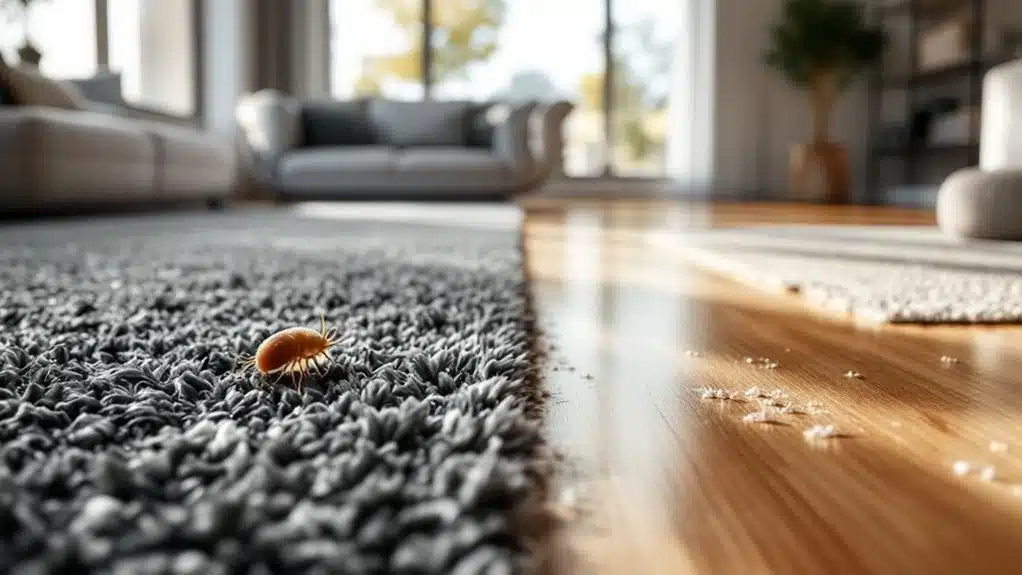
Carpet ranks as the single most problematic flooring option for allergy sufferers, and the structural reasons are straightforward. Carpet fibers create a dense, layered matrix that traps particulate matter deep beneath the surface pile. Standard flooring maintenance — even frequent vacuuming — won’t extract allergens embedded below the fiber base. Studies confirm that allergen retention in carpet notably exceeds retention rates in hard-surface flooring. Dust mites reproduce prolifically within carpet’s warm, fiber-rich environment, compounding the contamination cycle. When foot traffic disturbs the surface, previously settled particles re-enter your breathing zone, directly compromising air quality. In contrast, non-porous materials like vinyl flooring resist mold and bacterial growth, making them superior choices for allergy management. Shag, plush, and loop-pile constructions perform worst because of their increased surface area. If you’re managing allergies on behalf of vulnerable household members, carpet presents a measurable, clinically supported risk.
Why Carpet Is Every Allergen’s Favorite Hiding Spot
Understanding why carpet accumulates allergens so effectively requires a closer look at its physical structure. Carpet fibers create a dense, textured matrix that traps dust mites, pet dander, mold spores, and pollen deep within their weave. Standard vacuuming often doesn’t fully extract these particles, allowing allergen accumulation to persist long-term. In contrast, hard flooring options like LVP flooring require only regular sweeping or vacuuming to maintain allergen-free surfaces.
| Allergen Type | Carpet Fiber Behavior | Removal Difficulty |
|---|---|---|
| Dust Mites | Burrow deep into pile | High |
| Pet Dander | Clings to fiber surfaces | Moderate–High |
| Mold Spores | Thrive in moisture-retaining fibers | High |
| Pollen | Settles between fiber clusters | Moderate |
| Bacteria | Colonizes fiber base layers | Very High |
You’re fundamentally maintaining a biological reservoir beneath your feet, making carpet a clinically inadvisable choice for allergen-sensitive households you serve.
The Best Flooring Options for Allergy Sufferers

If you’re replacing your floors with allergy management in mind, hardwood and tile are your strongest evidence-based choices, as their non-porous surfaces don’t trap dust mites, pet dander, or mold spores the way carpet fibers do. You can clean both materials with a damp mop or HEPA-filtered vacuum, eliminating allergens rather than redistributing them. If removing carpet entirely isn’t feasible, you’ll want to select low-pile options with a dense weave, as they accumulate considerably fewer allergens than high-pile or shag varieties and respond better to routine vacuuming. Luxury vinyl planks offer another excellent alternative for allergy sufferers since their non-porous surfaces resist moisture and allergen accumulation while remaining easy to maintain.
Hardwood and Tile Benefits
When choosing flooring to minimize allergen exposure, hardwood and tile consistently outperform other materials in clinical and environmental health assessments. Their non-porous surfaces prevent dust mites, pet dander, and mold spores from embedding deeply. Hardwood durability guarantees decades of allergen-resistant performance, while tile maintenance requires only routine damp-mopping to eliminate surface contaminants effectively. Unlike carpets that trap dust and allergens, hardwood flooring creates a healthier indoor environment for allergy sufferers and those with asthma.
| Feature | Hardwood | Tile |
|---|---|---|
| Allergen Retention | Very Low | Minimal |
| Maintenance Frequency | Weekly | Bi-weekly |
| Durability Rating | 25–100 years | 20–50 years |
You’ll find both options considerably reduce airborne particulate accumulation compared to carpet. When serving clients with respiratory sensitivities, recommending these surfaces provides measurable, evidence-supported health outcomes backed by indoor air quality research.
Low-Pile Carpet Considerations
Although hardwood and tile represent the gold standard for allergy management, low-pile carpet remains a viable option when you select and maintain it correctly. Low pile benefits include reduced fiber density, which limits the surface area where dust mites, pet dander, and pollen accumulate. Clinical studies confirm that shorter fiber construction releases fewer allergens into breathing zones compared to plush alternatives.
To maximize these advantages, apply these maintenance tips consistently: vacuum twice weekly using a HEPA-filtered machine, schedule professional steam cleaning every six months, and treat stains immediately to prevent mold colonization. You’ll additionally want to select carpets certified by the Carpet and Rug Institute’s Green Label Plus program. Consider pairing low-pile carpet with slip-resistant coatings in high-traffic areas to enhance both safety and allergen management in your home. These evidence-based practices help you create safer environments for the allergy-sensitive individuals you’re committed to serving.
Hardwood, Tile, or Vinyl: Which Wins for Allergy Sufferers?
Choosing between hardwood, tile, and vinyl flooring requires weighing specific allergen-trapping properties, maintenance demands, and surface porosity against one another. Hardwood benefits include a smooth, non-porous surface that resists allergen accumulation when properly sealed and maintained. On the other hand, unsealed gaps between planks can harbor dust mites and mold spores.
Tile maintenance is straightforward — its impermeable surface prevents allergen penetration, though grout lines require consistent cleaning to avoid microbial buildup. You’ll want to seal grout annually to maintain allergen resistance. For bathroom applications specifically, textured tile finishes provide additional safety benefits beyond allergen control.
Vinyl durability makes it a practical option for high-traffic environments, as its seamless installation eliminates gaps where particulates collect. Among these three options, tile and sealed vinyl provide the strongest allergen resistance overall, offering those you serve measurably cleaner indoor air quality.
VOC Ratings, Texture, and What Allergy-Friendly Flooring Labels Mean

Understanding VOC ratings, surface texture, and certification labels is essential before you commit to any allergy-friendly flooring purchase. VOC levels indicate chemical off-gassing, which can trigger respiratory responses in sensitive individuals. Look for GREENGUARD Gold or FloorScore certifications, as these flooring labels confirm independently verified low-emission standards.
Texture types markedly influence allergen accumulation. Smooth, non-porous surfaces create effective allergen barriers, preventing dust mites and particulate matter from embedding within the material. Conversely, embossed or hand-scraped textures harbor allergens in spite of appearing easy to clean. Luxury vinyl plank flooring offers water-resistant, smooth surfaces that naturally resist dust and allergen accumulation compared to traditional porous materials.
When evaluating products, cross-reference VOC levels against certification data rather than relying solely on manufacturer claims. Clients you’re helping select flooring deserve evidence-based guidance that prioritizes measurable indoor air quality outcomes over aesthetic or marketing-driven decisions.
The Best Flooring for Allergy Sufferers in Every Room
Each room in your home presents distinct allergy challenges, requiring targeted flooring solutions based on moisture exposure, foot traffic, and airborne allergen accumulation patterns. In bedrooms, you’ll want to prioritize low-pile or hard-surface flooring that minimizes dust mite habitats, while kitchens and bathrooms demand moisture-resistant, non-porous materials that inhibit mold and bacterial growth. For living rooms, your best options balance durability and easy maintenance, with hard flooring surfaces like hardwood or luxury vinyl consistently outperforming carpet in allergen reduction studies. Cork flooring’s antimicrobial properties make it an excellent choice for reducing mold and odor accumulation in moisture-prone areas throughout your home.
Bedroom Flooring Allergy Tips
Since the bedroom is where most people spend roughly a third of their lives, it carries a disproportionately high allergen burden — dust mites, pet dander, and mold spores accumulate in flooring materials and become airborne during sleep and movement. Pair eco friendly materials with effective ventilation systems to minimize exposure.
| Flooring Type | Allergen Risk |
|---|---|
| Hardwood | Low |
| Carpet | High |
| Cork | Moderate |
| Tile | Low |
Choose sealed hardwood or tile for clinically measurable allergen reduction. Avoid wall-to-wall carpet, which harbors dust mite colonies at densities exceeding 100,000 per square meter. If you’re caring for allergy-sensitive individuals, prioritize smooth, non-porous surfaces that support consistent, effective cleaning protocols.
Kitchen and Bathroom Choices
Kitchens and bathrooms present a distinct allergen profile compared to bedrooms — moisture accumulation, mold spore proliferation, and food particulate matter dominate these environments rather than dust mites. You’ll want water resistant options like porcelain tile, luxury vinyl plank, or sealed concrete, as these materials inhibit mold colonization at the substrate level. Grout lines, nonetheless, require antimicrobial sealants applied routinely, since unsealed grout harbors fungal growth. Prioritize slip resistant surfaces textured sufficiently to prevent falls without creating microgrooves that trap biological debris. Avoid natural stone unless professionally sealed, as its porosity makes it particularly susceptible to allergen accumulation. Sheet vinyl remains clinically practical — its seamless installation eliminates particulate infiltration points entirely. For clients managing respiratory conditions, these two rooms demand your most rigorous material selection.
Living Room Floor Options
Living rooms introduce a complex allergen matrix — pet dander, tracked-in pollen, and high foot traffic collectively accelerate particulate accumulation across larger surface areas. You’ll need flooring that balances living room aesthetics with flooring durability while minimizing allergen retention.
| Flooring Type | Allergen Performance |
|---|---|
| Hardwood | Low retention, easy cleaning |
| Luxury Vinyl Plank | Non-porous, moisture-resistant |
| Polished Concrete | Minimal particle trapping |
| Low-pile Carpet | Moderate allergen accumulation |
| High-pile Carpet | High allergen entrapment risk |
Hard, sealed surfaces consistently outperform soft textiles in allergen management. When you’re serving households with sensitive individuals, prioritize hardwood or luxury vinyl — both resist dander embedding and support frequent damp-mopping protocols proven to reduce airborne particulate reintroduction.
Does Flooring Alone Actually Fix Your Allergy Problem?
While swapping out your flooring can meaningfully reduce allergen load in your home, it won’t resolve your allergy problem on its own. Allergy triggers extend beyond floor surfaces — they accumulate in upholstered furniture, bedding, HVAC systems, and wall materials. Flooring maintenance, including regular damp mopping and HEPA vacuuming, remains crucial even after you’ve installed low-allergen surfaces. Without consistent cleaning protocols, hard floors can still harbor dust mite debris, pet dander, and mold spores. You’ll additionally need to address ventilation, air filtration, and humidity control to create a thoroughly low-allergen environment. Think of flooring as one critical variable within a broader allergen-reduction strategy — necessary, but not sufficient. Managing your clients’ or household members’ symptoms effectively requires a systematic, multi-component approach rather than a single material upgrade.
How to Keep Any Floor Cleaner and More Allergen-Free

Regardless of which flooring material you install, your cleaning protocol determines how effectively that surface controls allergen accumulation. Implement these evidence-based allergen strategies consistently:
- Floor cleaning: HEPA-filtered vacuums reduce fine-particle dispersal during vacuum techniques more effectively than standard models.
- Air purifiers: Position HEPA-certified units strategically to capture airborne particulates your floor cleaning disturbs.
- Humidity control: Maintain indoor humidity between 30–50% to inhibit dust mite and mold proliferation.
- Maintenance tips: Microfiber mops trap allergens rather than redistributing them.
- Seasonal cleaning: Deep-clean quarterly, prioritizing high-traffic zones where accumulation concentrates.
- Pet care: Groom pets frequently and designate pet-free sleeping areas to reduce dander deposition.
Combining these protocols maximizes allergen reduction regardless of your flooring choice.
Frequently Asked Questions
Can Flooring Choices Affect Allergy Symptoms in Pets Too?
Yes, your flooring choices directly impact your pet’s allergy symptoms. You’ll want to select hypoallergenic options like tile or hardwood, as pet-friendly materials minimize trapped dander, dust mites, and allergens that trigger respiratory distress in sensitive animals.
Does Humid Climate Affect How Allergens Settle on Different Floors?
Like Noah’s flood, humidity levels worsen allergen accumulation. You’ll
Are Heated Floors More Likely to Circulate Allergens Through Rooms?
Heated floors don’t considerably circulate allergens more than cold surfaces. Nevertheless, you’ll notice that heated vs. cold temperature differentials can create convection currents, subtly increasing dust circulation. Guarantee proper ventilation and regular cleaning to minimize airborne allergen exposure effectively.
Can Area Rugs Over Hard Floors Still Trigger Allergy Symptoms?
Yes, they can. Area rug materials trap allergens just as wall-to-wall carpet does — and if you’re not increasing your cleaning frequency considerably, you’re unknowingly exposing sensitive individuals to persistent dust accumulation beneath them.
Does Flooring Color Make Dust and Allergens More Visually Noticeable?
Yes, flooring materials’ color impact matters — you’ll notice dust more on dark floors. Mid-tone flooring helps you spot allergens earlier, prompting timely cleaning that protects those you care for from unnecessary exposure.
Conclusion
Your flooring fundamentally affects how freely allergens flow through your home. You’ve now seen the science — smooth surfaces shed particles, while carpet captures and conceals them. But flooring fixes only part of the problem. You’ll still need strategic sweeping, smart sourcing of low-VOC materials, and systematic air filtration to truly tackle your triggers. Treat your floors as one clinical component of a thorough, evidence-based allergy management plan — not a standalone solution.