
Can You Install Hardwood Over a Concrete Slab in a Georgia Home?
You can install hardwood over a concrete slab in your Georgia home, but the state’s punishing humidity makes moisture control the difference between floors that last decades and floors that warp within months. Engineered hardwood outperforms solid hardwood over concrete because of its cross-ply construction, and proper moisture testing is non-negotiable before any installation begins. The right species selection, installation method, and vapor barrier strategy will determine whether your floors survive Georgia’s climate long-term.
Key Takeaways
- Yes, hardwood can be installed over concrete slabs in Georgia, but engineered hardwood outperforms solid hardwood in the state’s humid subtropical climate.
- Moisture testing is essential before installation; acceptable levels are ≤3 lbs per 1,000 sq ft/24 hrs or ≤75% relative humidity.
- Moisture-resistant species like White Oak, Brazilian Cherry, and Hickory perform best over concrete in Georgia’s high-humidity conditions.
- Proper slab preparation requires a clean, level, dry surface with cracks repaired, high spots ground down, and contaminants fully removed.
- Vapor barriers, such as 6-mil polyethylene or epoxy coatings, are critical for preventing warping, buckling, or delamination in Georgia’s climate.
Why Georgia’s Humidity Makes Hardwood Over Concrete Risky
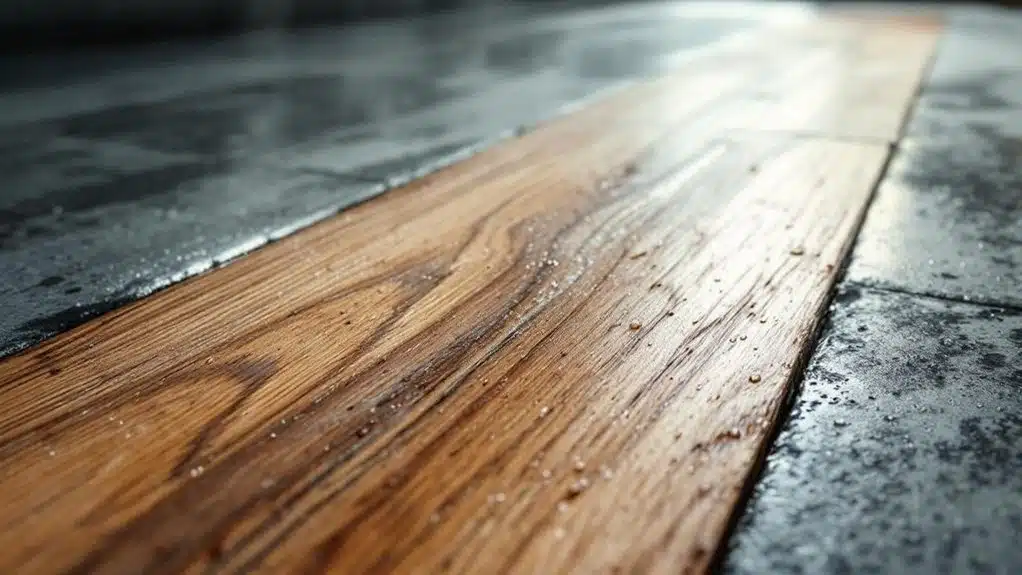
Georgia’s humid subtropical climate creates a uniquely challenging environment for hardwood flooring installed over concrete slabs. You’re dealing with average relative humidity levels exceeding 70%, which dramatically accelerates moisture migration through concrete. This creates significant installation challenges, as wood naturally expands and contracts in response to humidity effects throughout Georgia’s seasonal cycles.
Concrete acts as a moisture reservoir, continuously releasing vapor upward into your hardwood flooring. During Georgia’s hot summers, this vapor transmission intensifies, causing boards to cup, buckle, or warp. You must understand that concrete never fully dries—it perpetually holds and releases moisture.
Without proper moisture mitigation strategies, your hardwood installation will likely fail prematurely. Consider waterproof flooring alternatives like luxury vinyl plank or porcelain tile that are specifically designed to resist moisture damage in humid climates. These humidity effects compromise structural integrity, void manufacturer warranties, and create costly remediation scenarios for the homeowners you’re serving.
Can You Actually Install Hardwood Over Concrete?
In spite of the moisture challenges outlined above, you can absolutely install hardwood over concrete—but success hinges on selecting the right method and executing proper moisture mitigation before a single board goes down. Not all hardwood types perform similarly on concrete slabs. Engineered hardwood outperforms solid hardwood in below-grade or on-grade applications due to its cross-ply construction, which resists dimensional movement. Your installation tips should prioritize three proven methods: glue-down, float, or a raised subfloor system. Each method demands a concrete moisture test first—specifically, a calcium chloride or relative humidity probe test. Georgia’s climate makes skipping this step costly. Match your chosen hardwood type and installation method to your slab’s actual moisture emission rate, and you’ll build a durable, long-lasting floor your clients will appreciate for years. Beyond structural performance, hardwood flooring also contributes to a healthier indoor environment by avoiding the dust and allergens that accumulate in other flooring materials, which is particularly beneficial for Georgia homeowners concerned about air quality.
Test Your Concrete Slab for Moisture First
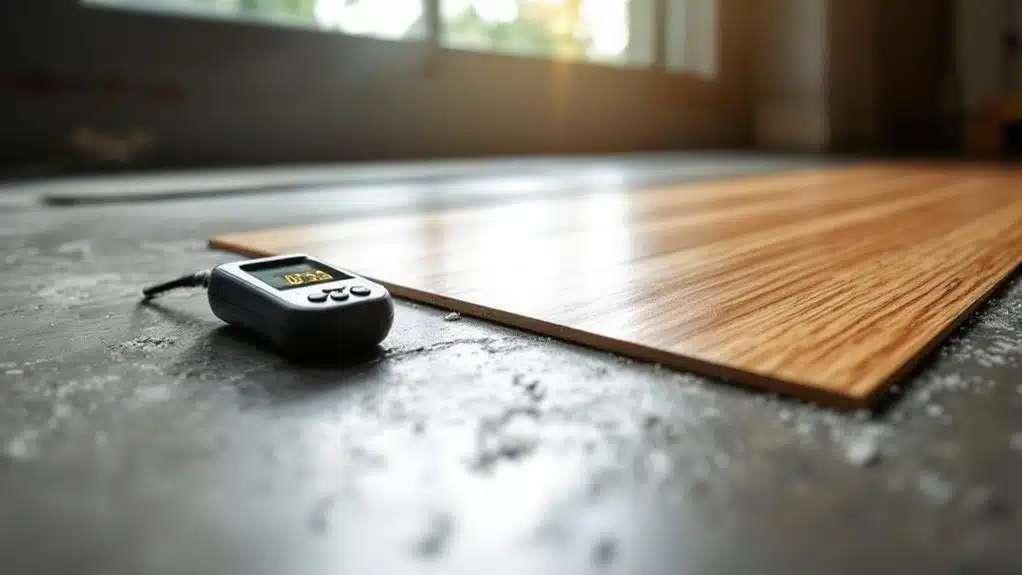
Before you install any hardwood over concrete, you must test the slab for moisture, since excess water vapor will cause your flooring to warp, buckle, or delaminate over time. You can use several testing methods, including the plastic sheet test (ASTM D4263), the calcium chloride test (ASTM F1869), or the relative humidity probe test (ASTM F2170), with the latter two providing the most quantifiable and reliable results. Most hardwood flooring manufacturers require a calcium chloride reading below 3 lbs per 1,000 sq ft per 24 hours, or a relative humidity level below 75–80% RH, before they’ll approve installation. In Georgia’s humid climate, selecting high-quality underlayment with moisture barriers will provide essential protection for your hardwood flooring investment.
Why Moisture Testing Matters
Moisture is concrete’s most destructive weapon against hardwood flooring, and testing your slab before installation can mean the difference between a floor that lasts decades and one that warps, buckles, or grows mold within months. Understanding moisture impact helps you protect your clients’ investments and your professional reputation. Testing importance can’t be overstated—Georgia’s humid climate accelerates moisture-related failures considerably. Working with flooring specialists with over 20 years of experience ensures you have access to expert consultation and professional installation methods that account for regional moisture challenges.
| Moisture Level | Risk Level | Recommended Action |
|---|---|---|
| Below 3 lbs | Low | Proceed with installation |
| 3–7 lbs | Moderate | Apply vapor barrier |
| Above 7 lbs | High | Remediate before installing |
Use a calcium chloride test or relative humidity probe to get accurate readings. Never skip this step—it’s your first line of defense.
Common Moisture Testing Methods
Three primary methods exist for testing concrete slab moisture, and each one delivers a different level of accuracy and insight. The plastic sheet test requires taping polyethylene film to the slab for 72 hours and checking for condensation underneath. It’s inexpensive but imprecise. The calcium chloride test measures moisture vapor emission rates using specialized testing equipment placed over the slab for 60–72 hours, giving you quantifiable data in pounds per 1,000 square feet per 24 hours. The most accurate option is in-situ relative humidity (RH) testing, where you insert probes directly into drilled holes to measure moisture at depth. Georgia’s flooring professionals typically recommend RH moisture testing as it reflects actual conditions within the slab rather than just surface-level readings. Before proceeding with hardwood installation, check for necessary subfloor repairs to prevent moisture-related issues that could compromise your new flooring’s integrity and longevity.
Acceptable Moisture Level Ranges
Once you’ve completed moisture testing, you’ll need to compare your results against established thresholds to determine whether your slab is ready for hardwood installation.
| Test Method | Acceptable Range |
|---|---|
| Calcium Chloride | ≤ 3 lbs/1,000 sq ft/24 hrs |
| Relative Humidity Probe | ≤ 75% RH |
| Pin-Type Meter | ≤ 4% moisture content |
Georgia’s humidity effects make these thresholds especially critical, as seasonal fluctuations can push borderline slabs past acceptable limits. If your readings exceed these ranges, don’t proceed with installation. Instead, apply appropriate moisture barriers to bring levels within acceptable parameters.
For homeowners concerned about moisture in Georgia’s climate, LVP flooring offers an inherently water-resistant alternative that eliminates many of these installation challenges. Readings near the upper thresholds warrant extra caution—install high-quality moisture barriers regardless, since Georgia’s climate creates unpredictable long-term conditions that could compromise your hardwood investment.
What Do Your Moisture Test Numbers Mean?

Once you’ve completed your moisture tests, you’ll need to interpret the numbers correctly to determine if your concrete is ready for hardwood installation. Most flooring manufacturers consider readings at or below 3 lbs per 1,000 sq ft per 24 hours (using the calcium chloride test) or 75% RH (using in-situ probes) as acceptable thresholds. If your readings exceed these limits, you’re risking serious consequences—including warping, buckling, and mold growth—so you’ll need to address the moisture problem before proceeding. In Georgia’s subtropical climate like Warner Robins, humidity fluctuations can significantly impact both your concrete moisture levels and the long-term performance of your hardwood floors, making pre-installation testing even more critical.
Acceptable Moisture Level Ranges
Now that you’ve run your moisture tests, you need to know what your numbers actually mean. For concrete slabs, acceptable moisture levels vary by testing method. The ASTM F2170 in-situ RH test should read 75% or below for most hardwood installations. The ASTM F1869 calcium chloride test should yield no more than 3 lbs of moisture per 1,000 square feet per 24 hours.
If your readings exceed these thresholds, you’ll need moisture control measures before proceeding. These include applying vapor barriers, moisture-mitigation coatings, or epoxy sealers to the slab surface. Your installation techniques will likewise depend on these readings—engineered hardwood tolerates slightly higher moisture levels than solid hardwood. Readings above acceptable ranges make floating or glue-down methods necessary rather than nail-down installation. For homeowners in Georgia seeking professional guidance on moisture control and installation methods, consulting with a flooring specialist who has extensive experience with concrete slab installations can ensure your hardwood flooring project succeeds.
High Readings And Risks
Understanding what high readings actually mean for your installation helps you make educated choices before problems develop. When your concrete slab registers above 75% RH or exceeds 3 lbs per 1,000 square feet using the calcium chloride method, you’re facing serious installation challenges that require immediate attention.
Elevated moisture creates several damaging outcomes for hardwood:
- Cupping occurs when board edges rise higher than their centers
- Buckling happens when boards lift completely off the subfloor
- Mold growth develops beneath flooring, threatening indoor air quality
Effective moisture control becomes non-negotiable at these readings. You’ll need to either delay installation until levels stabilize, apply a moisture mitigation system, or reconsider your flooring material entirely. Maintaining ideal relative humidity levels between 35% and 55% will help prevent future moisture-related damage even after successful installation. Ignoring high readings guarantees premature flooring failure.
Slab Problems You Must Fix Before Installation
Before you lay a single plank, your concrete slab must meet three critical conditions: it must be clean, level, and dry. A thorough slab inspection reveals whether you’re dealing with cracks, heaving, or surface contamination that will compromise your installation.
Address cracks wider than 1/8 inch using polyurethane or epoxy injection repair options before proceeding. High spots exceeding 3/16 inch over 10 feet require grinding, while low spots need leveling compound. Remove all paint, adhesive residue, oil stains, and efflorescence completely — these contaminants prevent proper bonding and moisture barriers from sealing correctly.
Never skip these corrections hoping the flooring will compensate. Structural deficiencies transfer directly through your finished floor, causing squeaks, movement, and premature failure that ultimately disrupts the homeowners you’re serving. Water damage or warping in the underlying slab will prevent successful installation, just as water damage undermines hardwood floor refinishing or replacement options.
Engineered vs. Solid Hardwood Over Concrete Slabs

With your slab clean, level, and dry, your next decision directly determines whether your installation succeeds long-term: choosing between engineered and solid hardwood.
Engineered hardwood wins this material comparison decisively for concrete slabs. Its cross-ply construction resists moisture-driven expansion and contraction, making it dimensionally stable in Georgia’s humid climate. You can install it using glue-down, float, or nail-down installation techniques, giving you flexible options depending on slab conditions.
Solid hardwood, on the other hand, absorbs moisture aggressively and expands unpredictably against concrete. Most manufacturers void warranties when solid hardwood installs directly over slabs, particularly below-grade or on-grade applications.
For Georgia homeowners, engineered hardwood with a minimum 3mm wear layer delivers authentic hardwood aesthetics without compromising structural integrity. Choose thicker wear layers—4mm to 6mm—if you plan refinishing the floor later.
Vapor Barriers and Underlayment for Concrete Slabs
Concrete slabs emit moisture vapor continuously, and without proper protection, that vapor destroys your hardwood installation from below. You’ll need to understand both vapor barrier types and underlayment options before committing to your installation method.
For vapor barrier types, you can choose between 6-mil polyethylene sheeting, epoxy moisture-barrier coatings, or self-adhesive membranes. Each addresses different moisture emission rates measured in pounds per 1,000 square feet per 24 hours.
Underlayment options include cork, foam, or combination moisture-barrier/underlayment products specifically engineered for concrete subfloors. Georgia’s humid climate intensifies slab moisture levels seasonally, making premium underlayment non-negotiable.
Always test your slab using the calcium chloride test before selecting materials. Emission rates exceeding three pounds require upgraded vapor barrier solutions to protect your clients’ flooring investments.
Three Methods for Installing Hardwood Over Concrete
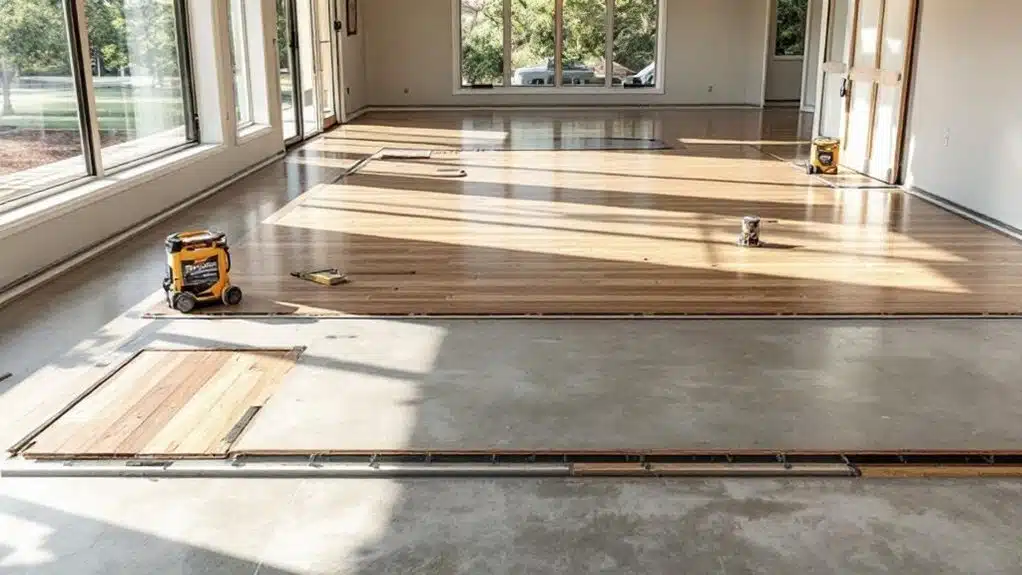
Three installation methods exist for hardwood over concrete, and each suits different flooring types, moisture conditions, and budget constraints. Your flooring options include floating, glue-down, and nail-down installation techniques, each carrying distinct advantages.
Floating installation places engineered hardwood over underlayment without bonding it to the slab, making it ideal for moisture-prone environments. Glue-down installation bonds solid or engineered hardwood directly to concrete using moisture-resistant adhesive, providing superior stability and sound reduction. Nail-down installation requires fastening a plywood subfloor to the concrete first, then nailing solid hardwood on top.
Georgia’s humid climate makes moisture assessment critical before selecting your method. Each technique demands proper surface preparation, verified moisture levels, and appropriate acclimation time to guarantee lasting performance for your clients or household.
Which Hardwood Species Hold Up Best in Georgia?
When selecting hardwood for a Georgia slab installation, you’ll need to prioritize species with high dimensional stability, as the state’s humid subtropical climate drives moisture content fluctuations that cause expansion and contraction. Engineered hardwood outperforms solid hardwood in these conditions due to its cross-ply construction, which resists cupping, warping, and gapping far better than solid planks glued or nailed directly over concrete. For solid hardwood, you’ll want to evaluate dense, tight-grained species like white oak, hickory, or hard maple, as they handle Georgia’s humidity swings with greater resilience than softer, more porous alternatives.
Best Species for Humidity
Georgia’s humid subtropical climate puts hardwood floors through serious stress, so species selection matters as much as installation method. Prioritizing humidity resistance and species durability safeguards your clients’ investments long-term.
Top-performing species for Georgia’s conditions include:
- White oak – Dense grain structure resists moisture movement better than red oak, making it ideal for high-humidity environments
- Brazilian cherry (Jatoba) – Exceptional hardness and natural oils improve humidity resistance, reducing expansion and contraction cycles
- Hickory – Superior species durability handles dramatic seasonal humidity swings without compromising structural integrity
You’ll want to steer clients away from softer domestic species like pine or birch, which absorb ambient moisture quickly. Matching species characteristics to Georgia’s climate conditions guarantees floors perform reliably across decades of use.
Engineered vs. Solid Hardwood
Choosing between engineered and solid hardwood for a Georgia concrete slab installation isn’t purely a preference decision—it’s a structural and performance one. Solid hardwood expands and contracts considerably with humidity fluctuations, making it risky over concrete without a subfloor system. In Georgia’s climate, that movement creates cupping, warping, and gapping.
Engineered hardwood wins the durability comparison here. Its cross-ply construction resists moisture-driven movement, making it dimensionally stable in high-humidity environments. Installation techniques for engineered hardwood include glue-down, float, or staple-over-plywood methods—all compatible with concrete slabs.
When you’re helping homeowners select flooring, steer them toward engineered products with a wear layer of at least 3mm. This guarantees refinishing capability while maintaining long-term performance in Georgia’s demanding temperature and humidity conditions.
Local Climate Considerations
Not every hardwood species handles Georgia’s humidity and temperature swings similarly well, so species selection directly impacts how your floor performs over a concrete slab. Georgia’s climate impact on hardwood is significant, as temperature fluctuations between seasons cause expansion and contraction that stress less stable species.
Choose species that tolerate high humidity and movement:
- White oak resists moisture absorption effectively and maintains dimensional stability under Georgia’s humid conditions
- Hickory offers exceptional hardness, handling temperature fluctuations without excessive warping or gapping
- Teak contains natural oils that repel moisture, making it ideal for slab installations in humid climates
Prioritizing domestically stable species protects your clients’ investments long-term, reducing callbacks and costly repairs caused by preventable moisture-related floor failures common across Georgia’s varied regional climates.
What Does Hardwood Over a Concrete Slab Cost?
Installing hardwood over a concrete slab typically costs between $6 and $12 per square foot for materials and labor combined, though engineered hardwood installations tend to fall on the lower end of that range while solid hardwood floated or glued-down installations can push costs higher. Your installation costs will equally reflect Georgia’s humidity demands, since proper moisture mitigation—vapor barriers, subfloor layers, or epoxy moisture membranes—adds $1 to $3 per square foot. When evaluating material options, engineered hardwood runs $3 to $8 per square foot, while solid hardwood ranges from $5 to $10. Labor typically adds $3 to $5 per square foot. Budgeting accurately upfront helps you serve your clients or household with a durable, properly installed floor.
How to Find a Contractor for Slab Hardwood Installation
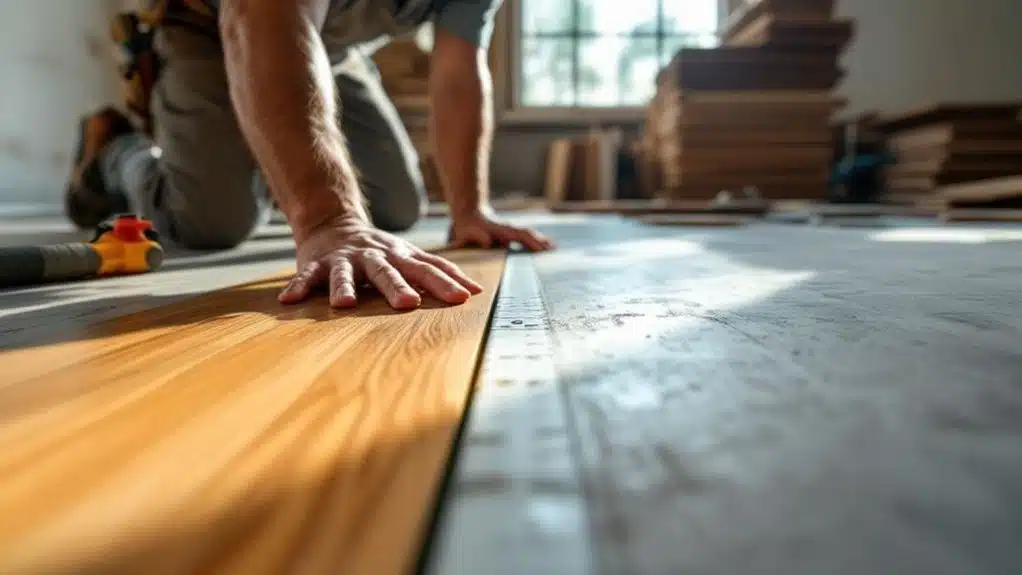
Finding the right contractor for hardwood-over-concrete installation requires more than a quick web search—you’ll need someone who specifically understands moisture mitigation, subfloor systems, and the expansion dynamics unique to slab installations.
When evaluating contractor qualifications and installation experience, prioritize professionals who can demonstrate:
- Documented slab projects with verifiable references from Georgia homeowners, confirming successful long-term outcomes
- Moisture testing protocols they routinely perform before recommending specific hardwood species or installation methods
- Manufacturer certifications that validate their familiarity with flooring systems designed for concrete substrates
Request detailed written proposals outlining their moisture mitigation strategy, subfloor approach, and acclimation timeline. A knowledgeable contractor won’t hesitate to explain their methodology clearly. If they skip these conversations, they’re likely not the right fit for your project.
Frequently Asked Questions
Can Hardwood Over Concrete Void My Georgia Homebuilder’s Warranty?
Installing hardwood over concrete can void your Georgia homebuilder’s warranty if you don’t follow proper installation guidelines. Always review your warranty implications carefully and consult your builder before proceeding to protect your coverage.
How Long Does Hardwood Installation Over Concrete Typically Take to Complete?
Like clockwork, your hardwood installation duration typically spans three to five days. You’ll need one to two days for concrete preparation, including moisture testing and leveling, then another two to three days for actual flooring installation.
Will Hardwood Over Concrete Affect My Home’s Resale Value in Georgia?
Hardwood over concrete can boost your home’s resale value, aligning with current Georgia resale trends. You’ll attract buyers since buyer preferences consistently favor hardwood floors, making your investment a practical, value-adding choice for future transactions.
Can I Install Radiant Floor Heating Beneath Hardwood on Concrete Slabs?
You can install radiant floor heating beneath hardwood on concrete slabs. Investigate proper installation methods, including electric or hydronic systems, to maximize radiant benefits while maintaining wood stability and ensuring your clients’ comfort throughout Georgia’s varying seasons.
Does Homeowner’s Insurance Cover Hardwood Damage From Concrete Moisture Issues?
Like a shield with gaps, your homeowner’s insurance typically won’t cover hardwood damage from concrete moisture issues. You’ll find most insurers deny these insurance claims, as moisture barriers are your preventative responsibility, not sudden, accidental damage.
Conclusion
Think of your Georgia home as a ship traversing humid coastal waters—your concrete slab is the hull, and hardwood is the deck. You wouldn’t plank a deck without sealing the hull first. You’ve now got every tool you need: moisture testing protocols, remediation steps, installation methods, and species selection. Execute each phase correctly, and your hardwood floor will weather Georgia’s humidity for decades without warping, buckling, or delaminating.