
Engineered vs. Solid Hardwood: What Every Georgia Homeowner Should Know
For Georgia homeowners, engineered hardwood outperforms solid hardwood in the state’s humid subtropical climate because of its superior dimensional stability and resistance to moisture-related issues like cupping and gapping. While solid hardwood offers more refinishing cycles (5-10 versus 1-3) and longer lifespan, engineered products adapt better to Georgia’s 30-70% humidity fluctuations and work with various installation methods including basements and concrete slabs. Your flooring choice depends on room location, subfloor type, and whether you’ll prioritize immediate climate performance or long-term refinishing potential—factors we’ll break down room-by-room below.
Key Takeaways
- Engineered hardwood offers superior stability in Georgia’s 30-70% humidity range, resisting cupping and gapping better than solid hardwood.
- Solid hardwood allows 5-10 refinishes over 100+ years; engineered permits only 1-3 refinishes with 30-50 year lifespan.
- Engineered hardwood suits basements, kitchens, and concrete slabs; solid hardwood excels in living rooms, bedrooms, and hallways.
- Georgia’s 40°F+ seasonal temperature swings favor engineered hardwood’s layered construction for dimensional stability and reduced maintenance.
- Engineered hardwood costs $3-12 per square foot versus $5-15 for solid, with lower installation labor on click-lock systems.
Understanding the Construction Differences Between Engineered and Solid Hardwood
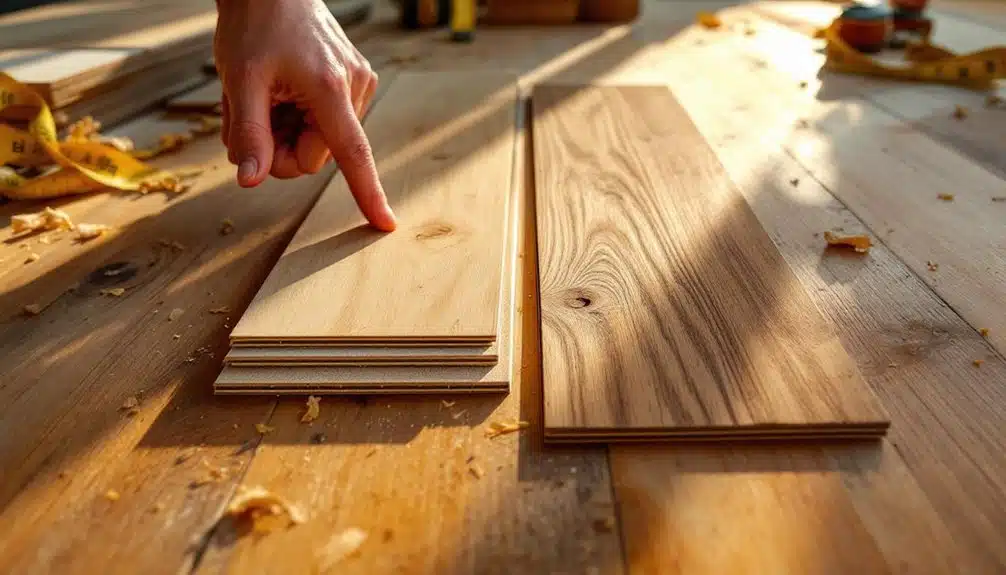
Before selecting flooring for your Georgia home, you’ll need to understand the fundamental structural differences between these two hardwood options. Solid hardwood consists of single-piece planks milled entirely from one wood species, typically 3/4-inch thick. You’re working with genuine wood throughout the entire board. Engineered hardwood, on the other hand, utilizes layered construction materials—a real hardwood veneer bonded atop multiple plywood or high-density fiberboard layers. This cross-grain core construction delivers superior flooring stability, particularly in Georgia’s fluctuating humidity levels. The multi-ply design resists expansion and contraction more effectively than solid wood. While solid hardwood offers refinishing versatility because of its thickness, engineered options provide dimensional stability that’ll better serve your clients in moisture-prone areas like basements, kitchens, or homes without climate control. The protective coatings on engineered hardwood also make it more water-resistant than traditional solid wood floors, an important consideration in humid climates.
How Georgia’s Climate Impacts Your Flooring Choice
Georgia’s humid subtropical climate presents specific challenges for hardwood flooring, with relative humidity levels fluctuating between 30-70% throughout the year and average temperatures ranging from 40°F in winter to 90°F in summer. These moisture and temperature variations cause wood to expand and contract, making your flooring choice critical for long-term performance. Coastal regions near Savannah and Brunswick face higher moisture exposure than inland areas like Atlanta, requiring additional consideration for dimensional stability in your hardwood selection. To protect your investment, maintain indoor humidity levels between 30% and 50% year-round using dehumidifiers during Georgia’s humid summer months and humidifiers in drier winter conditions.
Georgia’s Humidity and Moisture
While many regions experience seasonal moisture fluctuations, the Southeast’s subtropical climate presents year-round humidity challenges that directly affect hardwood flooring performance. Georgia’s average relative humidity hovers between 65-75%, exceeding the recommended 30-50% range for ideal wood stability.
| Climate Factor | Impact on Flooring | Professional Solution |
|---|---|---|
| High humidity (summer) | Wood expansion, cupping | Humidity control systems |
| Low humidity (winter) | Wood contraction, gapping | Whole-home humidification |
| Moisture intrusion | Subfloor damage, mold | Moisture barriers installation |
You’ll need to implement extensive moisture barriers during installation to protect your clients’ investments. Professional-grade vapor retarders beneath flooring prevent ground moisture migration, while proper HVAC-controlled humidity management maintains dimensional stability. These preventive measures guarantee long-term flooring integrity and customer satisfaction. In Georgia’s humid climate, waterproof flooring options like luxury vinyl plank and porcelain tile offer alternatives that eliminate moisture concerns while maintaining aesthetic appeal.
Seasonal Temperature Fluctuations Matter
Temperature swings in Georgia routinely exceed 40°F between summer peaks and winter lows, creating expansion-contraction cycles that stress flooring materials beyond moisture effects alone. You’ll need to evaluate how each flooring type handles these thermal stresses when serving your clients’ long-term interests.
Engineered hardwood’s layered construction provides superior temperature adaptation, with cross-grain plies counteracting dimensional changes. This stability reduces gaps, cupping, and buckling that compromise aesthetics and performance. Solid hardwood requires more intensive seasonal maintenance—you’ll monitor HVAC settings, apply humidification during winter months, and educate homeowners about acceptable movement ranges.
Your material selection directly impacts service calls and client satisfaction. Engineered products minimize callbacks related to thermal expansion, allowing you to allocate resources toward installations rather than remediation. Both options deliver the natural beauty and classic look that make hardwood an attractive choice for any home design. Factor temperature-related performance into your recommendations for durable, low-maintenance solutions.
Coastal vs. Inland Considerations
As humidity levels decrease considerably as you move from Georgia’s 100-mile coastal zone inland toward the Piedmont region, you’ll need distinct flooring strategies for each geographic area. Coastal considerations demand engineered hardwood’s multi-layer construction, which resists the persistent moisture from Atlantic air masses that penetrate Savannah, Brunswick, and St. Simons Island homes year-round. This stability protects your clients’ investments against cupping and warping. Meanwhile, inland challenges in Athens, Atlanta, and Rome involve dramatic seasonal swings rather than constant humidity. Here, you can confidently specify solid hardwood for clients prioritizing longevity and refinishing potential, though engineered options still serve basement installations and radiant heating systems effectively. For homeowners seeking alternatives in moisture-prone areas throughout Georgia, LVP flooring offers inherent water resistance that prevents warping and swelling while delivering the aesthetic appeal of natural wood. Match your flooring recommendations to your clients’ specific microclimates for best performance and satisfaction.
Moisture Resistance and Humidity Performance in Georgia Homes
Georgia’s subtropical climate creates year-round humidity levels that directly compromise hardwood flooring stability through moisture absorption and dimensional changes. You’ll need to understand how each flooring type responds to relative humidity fluctuations between 30-90% to prevent cupping, warping, and gap formation. Engineered hardwood’s cross-laminated construction provides superior dimensional stability compared to solid hardwood’s single-piece structure, which expands and contracts markedly with moisture variations.
Georgia’s High Humidity Challenges
When relative humidity consistently exceeds 70% during Georgia’s summer months, hardwood flooring faces significant dimensional stress that can compromise its structural integrity. You’ll need to implement robust humidity control systems to protect your clients’ investments and prevent cupping, crowning, or gapping.
Engineered hardwood’s cross-layered construction provides superior dimensional stability compared to solid wood in these conditions. The perpendicular grain orientation counteracts moisture-induced expansion, making it your reliable solution for coastal and subtropical installations.
However, proper flooring maintenance remains critical regardless of product selection. You should recommend dehumidifiers maintaining 35-55% relative humidity year-round. Installing moisture barriers over crawl spaces and concrete slabs creates additional protection layers. These proactive measures guarantee long-term performance and client satisfaction while minimizing warranty claims and callbacks.
How Each Type Performs
Understanding these environmental factors sets the foundation for evaluating real-world performance metrics between solid and engineered hardwood products. In Georgia’s humid climate, you’ll find engineered hardwood demonstrates superior dimensional stability because of its cross-layered construction, which resists moisture-induced expansion and contraction. This structural advantage translates to fewer gaps, reduced cupping, and minimized warranty claims for your clients. A durability comparison reveals solid hardwood excels in long-term refinishing potential—offering 4-6 refinishing cycles versus engineered’s 1-3 cycles. Nevertheless, engineered products maintain consistent performance in below-grade installations and over concrete slabs where moisture barriers prove challenging. When serving homeowners, you’ll maximize client satisfaction by matching product selection to specific installation conditions, traffic patterns, and humidity exposure levels throughout their homes.
Installation Options and Requirements for Each Flooring Type
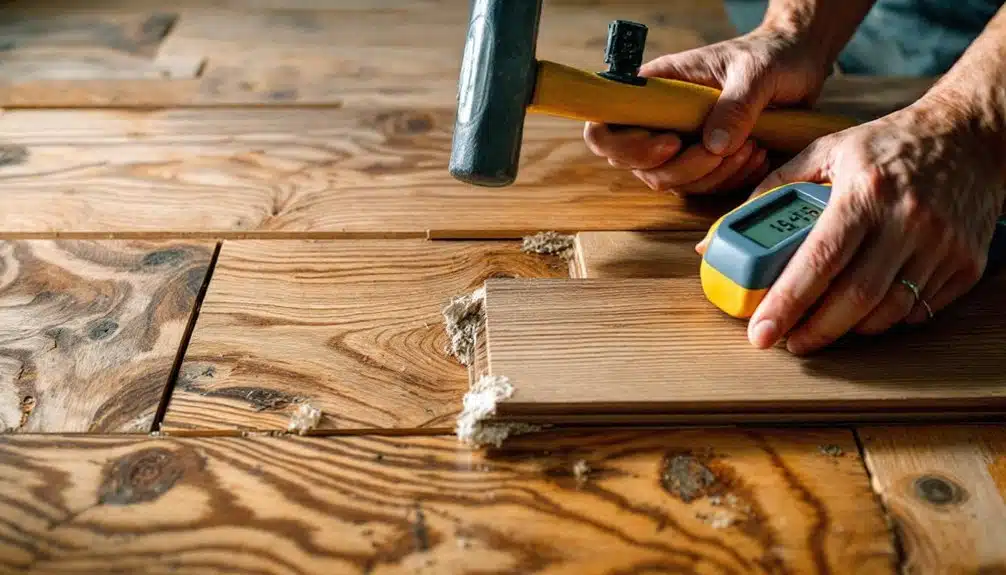
Before you commit to either flooring option, you’ll need to evaluate the installation requirements that differentiate engineered from solid hardwood. Solid hardwood demands nail-down or staple-down installation techniques over wooden subfloors, requiring specialized flooring tools like pneumatic nailers and moisture meters. You’ll need experience with tongue-and-groove systems and proper acclimation protocols.
Engineered hardwood offers your clients versatile installation methods: floating, glue-down, or nail-down applications. This flexibility allows you to serve homeowners with concrete slabs, basements, or challenging subfloor conditions where solid hardwood fails. The click-lock systems in many engineered products reduce labor costs and installation time considerably. You can confidently recommend engineered flooring for projects requiring radiant heating systems, where solid wood’s dimensional instability creates service complications.
Long-Term Durability and Refinishing Capabilities
Solid hardwood’s wear layer extends through its entire thickness, enabling multiple refinishing cycles throughout its 100-year potential lifespan. You’ll find this offers exceptional long-term value for homeowners seeking sustainable flooring solutions. Engineered hardwood’s thinner wear layer limits refinishing opportunities, yet premium versions with 4-6mm veneers support 2-3 refinishing techniques.
| Feature | Solid Hardwood | Engineered Hardwood |
|---|---|---|
| Refinishing Cycles | 5-10 times | 1-3 times |
| Wear Layer Depth | Full thickness (¾”) | 2-6mm veneer |
| Lifespan Expectancy | 100+ years | 30-50 years |
| Sanding Depth Available | ¼” maximum | 1-2mm maximum |
This durability comparison reveals solid hardwood’s superior longevity. Nonetheless, engineered options serve clients with moisture concerns effectively, provided you set appropriate expectations regarding refinishing limitations and replacement timelines.
Cost Comparison: Initial Investment and Lifetime Value
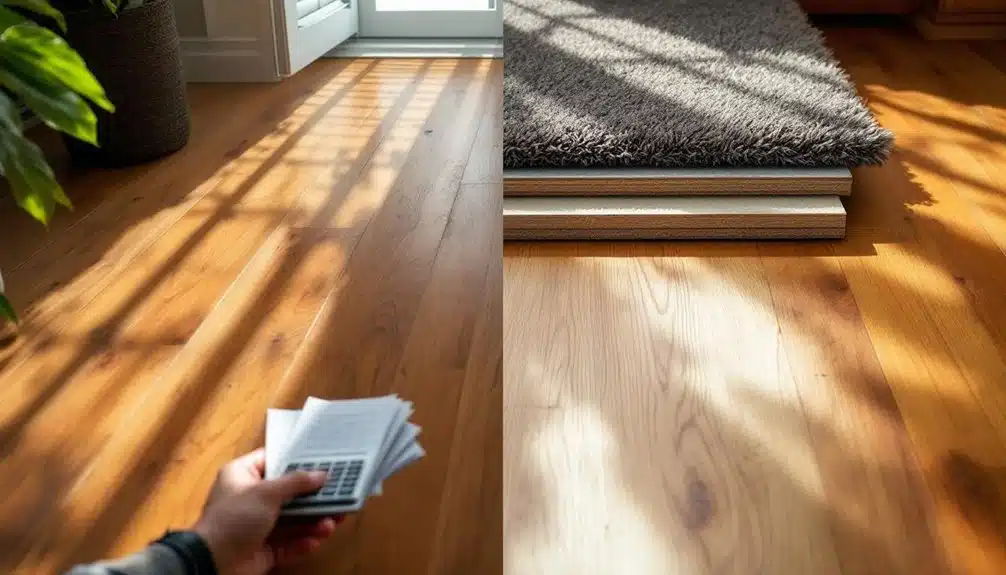
Material costs for engineered hardwood typically range from $3-12 per square foot, while solid hardwood commands $5-15 per square foot, creating an initial price advantage for engineered products. Nonetheless, you’ll need to evaluate total project costs including installation labor, which varies based on your chosen product and subfloor conditions.
When calculating long term savings for your clients, consider that solid hardwood’s refinishing capability—up to 7-10 times versus engineered’s 1-3 times—extends its functional lifespan considerably. While initial costs favor engineered options, solid hardwood often delivers superior lifetime value in stable environments. For Georgia’s humidity-prone regions, engineered flooring reduces moisture-related replacement expenses. You’re ultimately balancing upfront affordability against longevity, helping homeowners make well-informed choices aligned with their property’s specific conditions and budget constraints.
Best Rooms and Applications for Each Flooring Type
Room selection determines flooring performance outcomes, making product-to-application matching critical for Georgia installations. Solid hardwood excels in controlled environments—living rooms, dining areas, bedrooms, and hallways where humidity remains stable. You’ll maximize client satisfaction by recommending solid wood for above-grade installations in climate-controlled spaces. Engineered hardwood handles moisture fluctuations better, making it ideal for basements, kitchens, bathrooms, and concrete slab installations. You can confidently specify engineered products for below-grade applications where solid wood fails. The best rooms for engineered flooring include high-traffic areas requiring dimensional stability. Your flooring applications should account for Georgia’s humidity extremes—engineered products adapt to seasonal changes while maintaining structural integrity. Match substrate conditions to product specifications: concrete requires engineered options, while traditional wood subfloors accommodate both materials effectively.
Resale Value and Return on Investment for Georgia Homeowners
Hardwood flooring investments deliver 70-80% ROI in Georgia’s residential market, positioning both engineered and solid options as value-add improvements for your clients’ properties. Current resale trends indicate buyers prioritize authentic wood flooring, making strategic flooring selections critical for maximizing investment returns.
Consider these market-driven factors when advising homeowners:
- Solid hardwood appeals to luxury buyers seeking traditional craftsmanship in established neighborhoods like Druid Hills and Ansley Park
- Engineered products attract practical buyers in newer developments prioritizing durability and moisture resistance
- Wide-plank installations command premium pricing across Metro Atlanta’s competitive markets
- Light-to-medium stain finishes align with contemporary buyer preferences, outperforming darker alternatives in days-on-market metrics
Your flooring recommendations should balance upfront costs against projected appreciation, ensuring homeowners’ investments serve both immediate needs and future sale potential.
Conclusion
You’ll find that engineered hardwood captures 65% of Georgia’s flooring market—and for good reason. You’ve got the technical knowledge now to specify the right product for your project parameters. Consider your subfloor conditions, moisture loads, and refinishing requirements when making your selection. Both products deliver exceptional performance when you match their construction properties to your installation environment. Make your specification based on site conditions, not aesthetics alone.