Leak-Proof & Luxurious: The Schluter Difference in Custom Shower Installation
Schluter’s engineered shower systems replace traditional field-applied waterproofing with ANSI A118.10-certified components that eliminate the guesswork causing 90% of shower failures. You’ll get a bonded KERDI membrane that withstands 168+ hours at 15 psi—triple the minimum standard—backed by a lifetime warranty that actually transfers liability away from your installer. The prefabricated integration means you’re looking at 30% faster installation, zero cure delays, and verifiable moisture management that prevents those $8,000–$15,000 rebuild nightmares. The technical breakdown ahead reveals exactly how these components work together to deliver both performance and luxury.
Key Takeaways
- Schluter’s engineered waterproofing membrane creates a continuous barrier that bonds directly to substrates, preventing costly water infiltration and mold growth.
- Prefabricated components eliminate installation guesswork, reducing labor time by 30% while meeting ANSI A118.10 standards for reliability.
- Integrated drainage solutions with calculated slopes and pre-formed corners prevent water pooling and ensure moisture exits properly.
- Lifetime warranty on KERDI membranes protects against failures, transferring liability to Schluter and avoiding $8,000–$15,000 rebuild costs.
- Bond strength exceeding 200 psi and hydrostatic testing beyond 168 hours demonstrate superior performance compared to traditional methods.
What Makes Traditional Shower Waterproofing Methods Fall Short
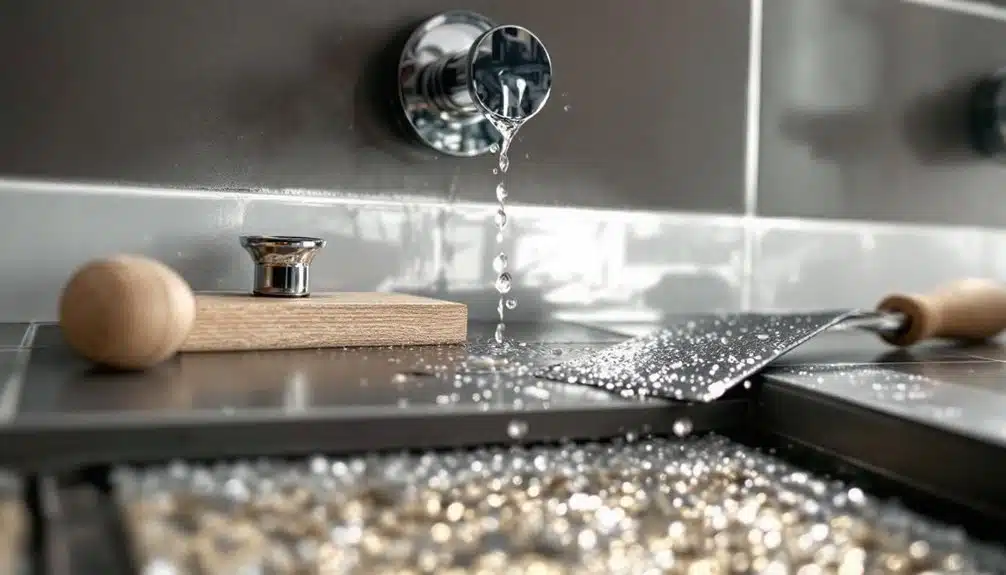
Traditional shower waterproofing relies on methods that haven’t evolved with modern building science. You’ve likely encountered installations using tar paper, mortar beds, and paint-on membranes—approaches that create waterproofing challenges your clients shouldn’t face. These traditional methods depend heavily on installer skill level and often lack integrated components, leaving critical vulnerabilities at junctions and penetrations.
The core issue? Moisture vapor can still penetrate behind the waterproof barrier, causing hidden deterioration you won’t detect until failure occurs. Paint-on membranes require precise thickness and cure times, while mortar beds crack under thermal expansion. You’re serving homeowners who deserve better than crossing your fingers and hoping the installation holds. Code compliance doesn’t guarantee long-term performance when the methodology itself creates opportunities for water infiltration and structural damage. This water in/water out approach ultimately leads to expensive mold remediation and structural issues that could have been prevented with modern waterproofing technology.
The Schluter System: An Engineered Approach to Shower Construction
The Schluter System replaces the uncertainty of field-applied waterproofing with factory-manufactured components engineered to meet ANSI A118.10 standards. You’ll work with load-bearing substrates like Schluter-KERDI-BOARD and bonded waterproofing membranes such as KERDI that integrate through specified thin-set mortars and sealing methods. Each component in the system—from drainage assemblies to corner seals—performs a defined role in creating a continuous waterproof envelope that you can verify during installation rather than hoping it holds after tile goes down. This integrated approach minimizes the risk of shower failures from moisture buildup that can lead to costly repairs and mold growth.
Waterproofing Innovation and Technology
When moisture penetrates behind tile assemblies, it compromises structural integrity and creates conditions for mold growth—a failure mode that’s plagued traditional mud-set installations for decades. Schluter addresses this with bonded waterproofing materials that integrate directly into your substrate assembly. Their KERDI membrane—a pliable sheet applied with thin-set mortar—creates a continuous barrier that meets ANSI A118.10 standards for load-bearing installations.
You’ll appreciate how these innovative techniques eliminate the guesswork fundamental in traditional waterproofing methods. The system’s prefabricated components—including corners, collars, and curbs—ensure proper lapping and sealing at critical junctures where failures typically occur. This engineered approach gives you code-compliant protection while serving your clients’ long-term interests. You’re not just installing tile; you’re delivering verified moisture management that protects their investment. This comprehensive protection makes installations eligible for a Schluter Lifetime Warranty that covers full cost, resolution, materials, and labor when properly installed.
Component Integration and Performance
Beyond waterproofing membranes alone, Schluter’s engineered advantage lies in how each component interfaces with the next to create a monolithic assembly. You’re working with a system where KERDI-BOARD, KERDI membrane, and KERDI-DRAIN aren’t isolated products—they’re designed for component synergy that meets IRC and IPC requirements.
When you bond the membrane to the substrate using unmodified thin-set, you’re creating mechanical adhesion that performance metrics prove superior to traditional pan liner methods. The prefabricated corners, pipe seals, and mixing valve integrations eliminate field-fabrication variables that compromise installations.
You’ll find each connection detail engineered to ANSI A118.10 standards, ensuring your clients receive showers where water management isn’t hoped for—it’s guaranteed through tested, load-rated assemblies. This integration protects your reputation while serving homeowners who trust your expertise. The sloped mortar bed beneath the shower floor works in concert with the drainage system to prevent water pooling and ensure efficient water flow throughout the installation’s lifespan.
Breaking Down the Core Components of a Schluter Shower

At its foundation, every Schluter shower system relies on five engineered components working in sequence: the shower pan (Kerdi-Shower-ST or SC), waterproofing membrane (Kerdi), bonded waterproofing strip (Kerdi-Band), pipe and mixing valve seals (Kerdi-Seal-PS and Kerdi-Seal-MV), and perimeter joint sealant (Kerdi-Fix or Kerdi-Coll-L). Your shower design demands precision integration of these elements to meet ANSI A118.10 waterproofing standards. Installation techniques require systematic layering—starting with slope-embedded pan systems, followed by membrane application using unmodified thin-set, then Kerdi-Band reinforcement at changes and corners. You’ll seal penetrations with dedicated rings before applying corner and edge strips. This methodical approach guarantees redundant protection layers that prevent water migration, safeguarding your clients’ investments while delivering code-compliant assemblies that perform reliably for decades. Selecting adhesives specifically formulated for wet environments ensures optimal bonding between membrane layers and substrate surfaces throughout the installation process.
Why the Kerdi Waterproofing Membrane Outperforms Conventional Alternatives
You’ll find that Kerdi’s polyethylene membrane bonds directly to the substrate using unmodified thin-set, creating a monolithic waterproofing layer that conventional paint-on or sheet membranes can’t match. This bonded system provides essential crack isolation up to 1/8″, protecting your tile assembly from substrate movement that typically causes grout and tile failures. The installation requires fewer steps than traditional mud-bed methods—you’re eliminating the scratch coat, waterproofing wait times, and multiple-day curing periods that add labor costs to your project.
Bonded Waterproofing Technology
When conventional waterproofing methods rely on topical sealants that sit above the substrate, they create a fundamental vulnerability: water that penetrates through grout lines or surface cracks becomes trapped between the barrier and the tile assembly. Schluter’s Kerdi membrane eliminates this risk through bonded waterproofing technology. You’ll bond the membrane directly to the substrate using unmodified thin-set mortar, creating a monolithic assembly where tile, waterproofing, and substrate function as one integrated system. This installation technique meets IRC and IPC code requirements while delivering waterproofing benefits that protect your clients’ investments. When moisture reaches the Kerdi layer, it can’t migrate laterally or penetrate deeper. You’re building assemblies that channel water exactly where it belongs—toward the drain—ensuring long-term performance in every shower you install.
Crack Isolation Benefits
Substrate movement poses one of the most persistent threats to tile assemblies, particularly in wood-framed construction where seasonal expansion, structural settling, and thermal cycling create stresses that rigid tile installations can’t accommodate. Schluter’s Kerdi membrane addresses this challenge through integrated crack isolation properties that conventional surface-applied membranes lack. The fleece webbing bonded to both sides of the polyethylene core creates a mechanical anchor that distributes stress across the assembly rather than transmitting it directly to tile bonds.
Your clients gain structural integrity benefits through this engineered flexibility—the membrane absorbs differential movement up to 1/8″ while maintaining waterproof integrity. These crack prevention strategies prove crucial in today’s building codes, where you’re protecting homeowners from catastrophic failures that compromise both investment and safety in their most moisture-critical spaces.
Faster Installation Process
Traditional waterproofing methods trap you in a multi-day installation cycle—applying liquid membranes in multiple coats, waiting 24-48 hours between layers, performing flood tests, then scheduling tile work only after complete cure times.
Schluter’s Kerdi membrane delivers efficient workflow through single-application bonding:
- Immediate tile-ready surface: Bond-set mortar simultaneously waterproofs and prepares substrate
- Eliminates cure delays: Proceed directly to tile installation without waiting periods
- Streamlined inspection points: Visual verification replaces time-consuming flood testing
- Reduced labor callbacks: Complete waterproofing and tile in continuous workflow
- Predictable project timelines: Consistent installation windows serve your clients’ scheduling needs
This time savings transforms multi-day processes into same-day execution. You’ll meet code requirements while delivering faster project completion—serving homeowners who need reliable installations without extended construction disruption.
The Science Behind Schluter’s Integrated Drainage Solutions
Since water follows the path of least resistance, Schluter’s integrated drainage solutions engineer that pathway with mathematical precision rather than leaving it to chance. You’re implementing drainage physics principles that direct moisture toward designated exit points through calculated slope integration—typically 1/4″ per foot minimum. This moisture management system eliminates pooling vulnerabilities that compromise traditional installations.
| System Component | Technical Function |
|---|---|
| Kerdi-Drain | Bonded waterproofing integration at critical junction |
| Slope Channel | Linear drainage with 360° rotational adjustment |
| Kerdi Membrane | Continuous vapor barrier with 0.01 perm rating |
| Pre-Sloped Tray | Factory-calibrated gradient eliminating field measurement error |
Your clients benefit from engineering that removes guesswork. Each component interfaces through tested protocols, creating redundant protection layers. You’re delivering systems where water behavior becomes predictable, controllable, and verifiable—transforming shower longevity from hopeful to guaranteed.
How Schluter Systems Eliminate Common Installation Errors
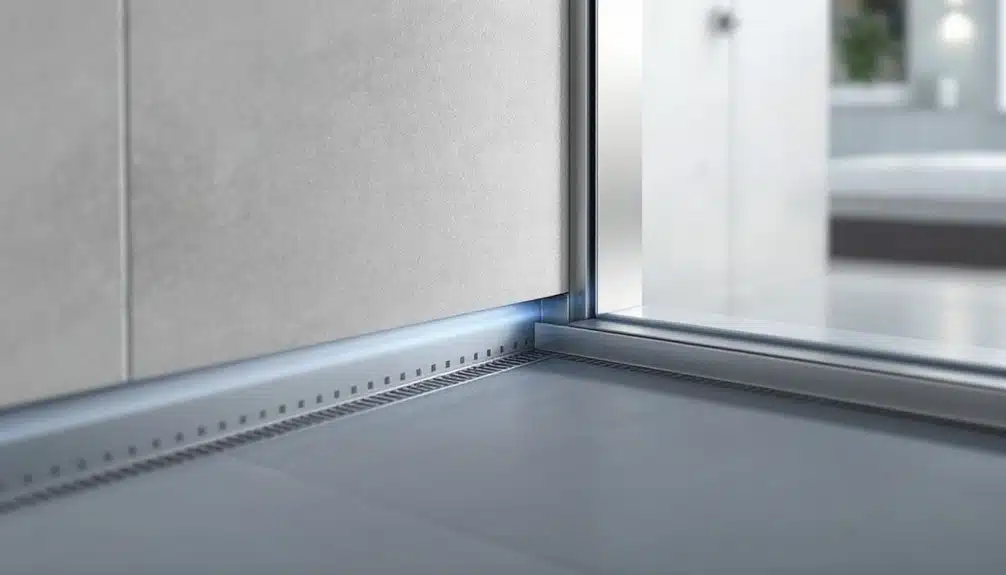
You’ve likely encountered shower failures traced back to three critical installation errors: compromised waterproofing membranes, inadequate slope causing standing water, and improper tile substrate preparation. Schluter’s engineered systems address each vulnerability through pre-formed components that meet ANSI A118.10 and IRC R307.2 requirements, replacing field-fabricated methods prone to human error. The integrated approach bonds waterproofing, slope management, and substrate preparation into a single installation sequence that eliminates the gaps between traditional trades.
Preventing Waterproofing Membrane Failures
Most shower leaks stem from three critical failures: improper membrane overlap, inadequate corner reinforcement, and unsealed penetrations. Schluter’s KERDI system addresses these vulnerabilities through engineered solutions that protect your clients’ investments.
The system maintains membrane integrity through:
- Pre-formed corners and collars that eliminate field-cut weak points
- Bonded fleece backing ensuring complete adhesive coverage
- Standardized 2-inch overlap specifications meeting ANSI A118.10
- KERDI-BAND reinforcement strips for all connections and joints
- Factory-sealed pipe penetrations preventing moisture intrusion
You’ll achieve consistent moisture protection by following Schluter’s documented installation sequence. The fleece-backed membrane bonds directly to substrate and tile, creating a monolithic barrier. This integrated approach eliminates the guesswork in traditional installations, giving you confidence that every shower meets waterproofing codes while serving homeowners who depend on your expertise.
Eliminating Slope and Drainage Issues
While proper waterproofing prevents exterior moisture intrusion, inadequate slope causes water to pool within the shower pan itself—creating the conditions for mold growth and structural damage that waterproofing alone can’t prevent. Schluter’s KERDI-SHOWER-KIT eliminates this critical failure point through engineered drainage solutions. The prefabricated foam pan arrives with factory-integrated slopes—typically 1/4″ per foot—that meet IRC and IPC requirements without field adjustments. You’re not relying on mortar screeds or eyeballing levels; the geometry’s precision-molded. This means you’ll serve your clients with code-compliant installations every time. The system accommodates center, linear, and offset drains, allowing slope adjustments for specific project needs. When water flows predictably to drainage points, you’re preventing the callbacks and warranty claims that compromise your reputation and your clients’ investments.
Avoiding Tile Installation Mistakes
Even when waterproofing and drainage meet code standards, tile installations fail when adhesion, lippage, and substrate preparation create structural vulnerabilities that undermine the entire assembly. Schluter’s integrated approach addresses these critical installation errors through engineered solutions that guarantee long-term performance for your clients.
The system prevents common mistakes through:
- Bonding flanges on membranes that assure mechanical attachment independent of mortar coverage
- Factory-formed corners eliminating field-folded membrane failures
- Predetermined slopes in foam trays removing substrate inconsistencies
- Height-adjustable drains guaranteeing perfect tile alignment across large-format installations
- Coordinated system components maintaining grout consistency specifications
You’ll deliver code-compliant installations since each component works together, eliminating the guesswork that causes callbacks. When substrate preparation follows Schluter protocols, tile assemblies perform as engineered systems rather than field-assembled experiments.
Warranty Protection That Actually Delivers Peace of Mind
Reliability becomes tangible when you examine Schluter’s warranty structure—it’s engineered around actual failure points, not marketing copy. The KERDI membrane carries lifetime warranty coverage against manufacturing defects, while DITRA-HEAT systems maintain 10-year protection on heating cables. You’re not gambling with your clients’ investment—you’re delivering documented peace assurance.
What separates this from typical warranties? Installation guidelines align directly with IRC and IBC requirements. Follow their specifications for substrate preparation, waterproofing overlaps, and membrane connections, and you’ve satisfied both code and warranty terms simultaneously. No gray areas exist between compliance and coverage.
Document your installations with photos at critical stages: substrate condition, membrane laps, drain assembly integration. When you’ve executed the system correctly, warranty protection reinforces the craftsmanship you’ve already delivered.
Long-Term Cost Savings: Why Schluter Pays for Itself
Warranty protection matters most when it prevents callbacks—and callbacks destroy profit margins faster than any material upcharge. You’ll recognize Schluter’s cost efficiency when you track your service calls over five years. The long term benefits compound through reduced labor costs and preserved client relationships.
Investment returns through prevention:
- Zero waterproofing failures eliminate tear-out expenses averaging $8,000–$15,000 per shower rebuild
- Prefabricated components reduce installation time by 30%, cutting labor overhead considerably
- Manufacturer-backed warranties transfer liability from your business to Schluter’s engineering team
- Consistent substrate performance eliminates tile lippage callbacks and remedial leveling work
- Single-source accountability streamlines problem resolution without finger-pointing between suppliers
You’re protecting tomorrow’s reputation while serving today’s clients. That’s strategic stewardship.
Real-World Performance: Durability Testing and Results
When manufacturers submit waterproofing systems to ANSI A118.10 protocol testing, they’re subjecting bonded assemblies to hydrostatic pressures that replicate decades of service conditions compressed into controlled laboratory cycles. Schluter’s membrane systems consistently exceed minimum testing standards, demonstrating measurable performance metrics that translate directly to your clients’ peace of mind.
| Test Parameter | Code Minimum | Schluter Performance |
|---|---|---|
| Hydrostatic Pressure | 72 hours @ 10 psi | 168+ hours @ 15 psi |
| Bond Strength | 50 psi | 200+ psi |
| Temperature Cycling | -20°F to 180°F | -40°F to 200°F |
These aren’t marketing claims—they’re documented results from independent laboratories. You’re installing systems engineered for institutional-grade service life, backed by verifiable data that satisfies even the most stringent building officials.
Choosing the Right Schluter Products for Your Custom Shower Project
Before selecting components from Schluter’s product matrix, you’ll need to map your substrate conditions, dimensional constraints, and drainage requirements against the specific performance characteristics of each system element. Successful Schluter product selection demands systematic evaluation of your shower project considerations:
- Kerdi-Board vs. Kerdi Membrane: Match substrate stability—board for new construction, membrane for retrofit applications
- Drain Selection: Specify flange diameter based on tile thickness and subfloor depth
- Profile Changes: Calculate exact edge conditions to determine JOLLY, QUADEC, or RONDEC specifications
- Niche Dimensions: Code-compliant rough opening dimensions before rough-in
- Slope Requirements: Pre-sloped trays versus field-formed applications
You’re serving clients who expect zero callbacks. Cross-reference technical data sheets with actual field measurements. Document every specification decision—your installation integrity depends on matching products to precise conditions.
Conclusion
Your shower’s waterproofing isn’t a place for shortcuts—it’s the foundation everything else depends on. Think of Schluter as your building envelope’s insurance policy: the membrane’s bonded substrate, integrated drainage channels, and pre-sloped trays eliminate the guesswork that plagues traditional mud-set installations. You’re not just meeting code; you’re exceeding it with a system that’s been torture-tested in real-world conditions. Install it right once, and you’ll never tear out a failed shower again.